Overview
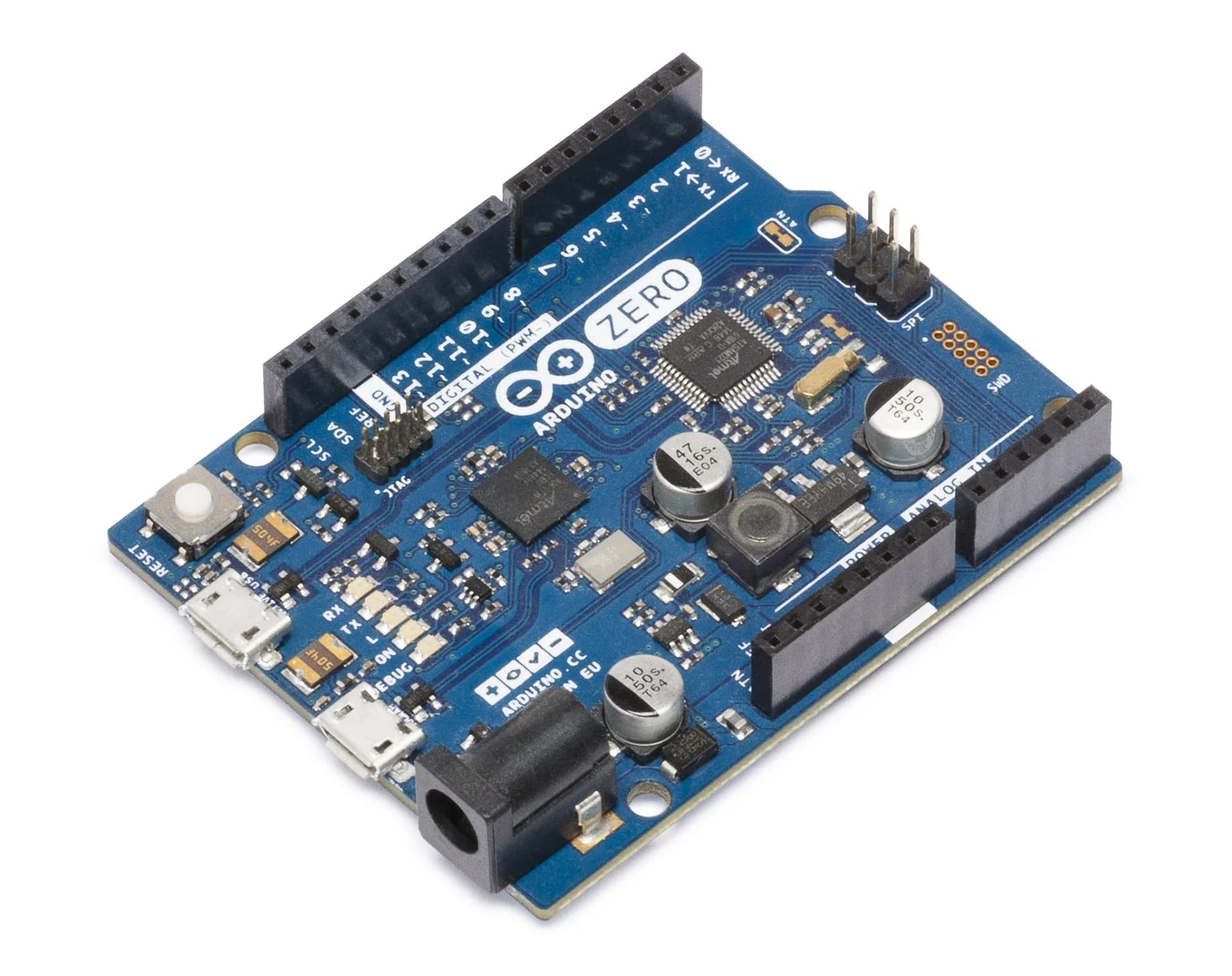
The Zero is a simple and powerful 32-bit extension of the platform established by the UNO. The Zero board expands the family by providing increased performance, enabling a variety of project opportunities for devices, and acts as a great educational tool for learning about 32-bit application development. The Zero applications span from smart IoT devices, wearable technology, high-tech automation, to crazy robotics. The board is powered by Atmel’s SAMD21 MCU, which features a 32-bit ARM® Cortex® M0+ core. One of its most important features is Atmel’s Embedded Debugger (EDBG), which provides a full debug interface without the need for additional hardware, significantly increasing the ease-of-use for software debugging. EDBG also supports a virtual COM port that can be used for device and bootloader programming.
Warning: Unlike most Arduino boards, the Zero runs at 3.3V. The maximum voltage that the I/O pins can tolerate is 3.3V. Applying voltages higher than 3.3V to any I/O pin could damage the board.
The board contains everything needed to support the microcontroller; simply connect it to a computer with a micro-USB cable or power it with a AC-to-DC adapter or battery to get started. The Zero is compatible with all the shields that work at 3.3V and are compliant with the 1.0 Arduino pinout.
You can find your board warranty information here.
Note
Arduino boards based on AVR microcontrollers get a reset and restart sketch execution each time the Serial Monitor of the Arduino Software (IDE) is opened. This is also the mechanism used to upload sketches to these boards. This board is different: when the Zero is connected through the Programming Port and you open the Serial Monitor, the board does not automatically reset and the sketch loaded keeps running. To restart the sketch you need to press the reset button on the board itself.
Tech specs
Microcontroller
ATSAMD21G18, 32-Bit ARM® Cortex® M0+
Operating Voltage
3.3V
Digital I/O Pins
20
PWM Pins
3, 4, 5, 6, 8, 9, 10, 11, 12, 13
UART
2 (Native and Programming)
Analog Input Pins
6, 12-bit ADC channels
Analog Output Pins
1, 10-bit DAC
External Interrupts
All pins except pin 4
DC Current per I/O Pin
7 mA
Flash Memory
256 KB
SRAM
32 KB
EEPROM
None. See documentation
LED_BUILTIN
13
Clock Speed
48 MHz
Length
68 mm
Width
53 mm
Weight
12 gr.
Documentation
OSH: Schematics
The Zero is open-source hardware! You can build your own board using the following files:
EAGLE FILES IN .ZIP SCHEMATICS IN .PDF
Pinout Diagram
Overview
The Zero is a simple and powerful 32-bit extension of the platform established by the UNO. The Zero board expands the family by providing increased performance, enabling a variety of project opportunities for devices, and acts as a great educational tool for learning about 32-bit application development. The Zero applications span from smart IoT devices, wearable technology, high-tech automation, to crazy robotics. The board is powered by Atmel’s SAMD21 MCU, which features a 32-bit ARM® Cortex® M0+ core. One of its most important features is Atmel’s Embedded Debugger (EDBG), which provides a full debug interface without the need for additional hardware, significantly increasing the ease-of-use for software debugging. EDBG also supports a virtual COM port that can be used for device and bootloader programming.
Warning: Unlike most Arduino boards, the Zero runs at 3.3V. The maximum voltage that the I/O pins can tolerate is 3.3V. Applying voltages higher than 3.3V to any I/O pin could damage the board.
The board contains everything needed to support the microcontroller; simply connect it to a computer with a micro-USB cable or power it with a AC-to-DC adapter or battery to get started. The Zero is compatible with all the shields that work at 3.3V and are compliant with the 1.0 Arduino pinout.
You can find your board warranty information here.
Note
Arduino boards based on AVR microcontrollers get a reset and restart sketch execution each time the Serial Monitor of the Arduino Software (IDE) is opened. This is also the mechanism used to upload sketches to these boards. This board is different: when the Zero is connected through the Programming Port and you open the Serial Monitor, the board does not automatically reset and the sketch loaded keeps running. To restart the sketch you need to press the reset button on the board itself.
Tech specs
Microcontroller
ATSAMD21G18, 32-Bit ARM® Cortex® M0+
Operating Voltage
3.3V
Digital I/O Pins
20
PWM Pins
3, 4, 5, 6, 8, 9, 10, 11, 12, 13
UART
2 (Native and Programming)
Analog Input Pins
6, 12-bit ADC channels
Analog Output Pins
1, 10-bit DAC
External Interrupts
All pins except pin 4
DC Current per I/O Pin
7 mA
Flash Memory
256 KB
SRAM
32 KB
EEPROM
None. See documentation
LED_BUILTIN
13
Clock Speed
48 MHz
Length
68 mm
Width
53 mm
Weight
12 gr.
Documentation
OSH: Schematics
The Zero is open-source hardware! You can build your own board using the following files:
EAGLE FILES IN .ZIP SCHEMATICS IN .PDF
Pinout Diagram
لماذا تتسوق معنا
تسوق بثقة
شحن سريع
إرجاع مجاني
دفع آمن
ضمان 30 يوماً
الدعم
الأسئلة الشائعة
المراجعات
مراجعات العملاء
كن أول من يشارك تجربته
ماذا يقول العملاء
لا توجد مراجعات بعد. اشتريت هذا المنتج؟ شارك رأيك أدناه.